

If your phone lit up this week with a link and a message like “this is literally us,” you’re not alone. A fake commercial on Saturday Night Live called “Sister” has become the most-shared thing in family caregiving circles in years. For millions of families caring for an aging parent, it was funny mostly because it was true.
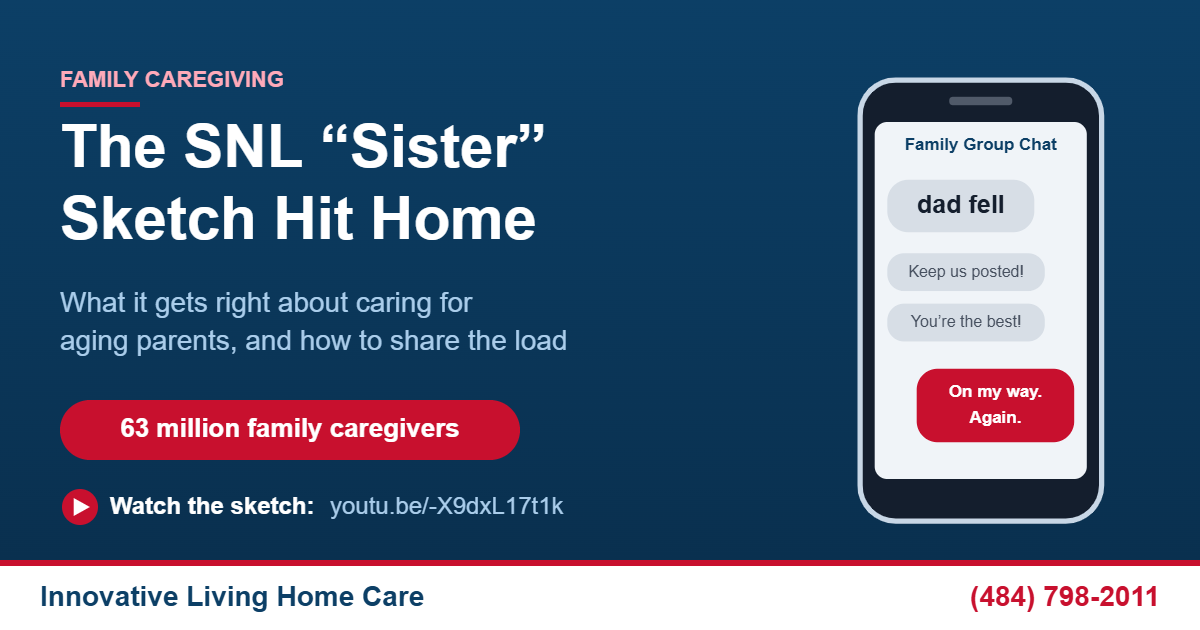
In the sketch, host John Mulaney pitches “Sister” as a revolutionary new service: a live-in, round-the-clock caregiver for your aging dad. To activate it, you just text two words: “dad fell.” Within hours, your actual sister quits her job, breaks her lease, moves across the country and takes over everything. She handles the doctors, the insurance company and the pharmacy, shouting “Speak to human!” into automated phone menus. The best part, the ad promises? She does it all for free.
Jane Wickline plays the exhausted sister and Tommy Brennan plays the aging father, with Kenan Thompson and Mikey Day rounding out the cast. The sketch aired the weekend of November 15 and pulled in more than 2 million YouTube views in its first day. As CNN reported, caregiving experts say it “hit a nerve.”
Want to watch it with us? 👇 Head over to our Facebook page, watch the sketch, and give us a 👍 Like so you never miss a caregiving tip.
Why the SNL “Sister” sketch hit home for family caregiving
The joke works because nearly every family has lived some version of it. One person, often a daughter but sometimes a son, a spouse or whoever lives closest, becomes the default caregiver. Everyone else is grateful, sends a thumbs-up to the family group chat and goes back to their lives.
5 facts behind the laughs
- Family caregiving is now part of everyday life for millions. According to AARP and the National Alliance for Caregiving, 63 million Americans are family caregivers, roughly 1 in 4 adults and about 20 million more than a decade ago.
- The load is rarely shared evenly. About 6 in 10 family caregivers are women, and one widely cited study found daughters spend more than twice as many hours a month on parent care as sons.
- Caregivers are stretched thin. Nearly two-thirds report high emotional stress, and about 6 in 10 are holding down a job at the same time.
- It’s expensive. AARP estimates family caregivers spend more than $11,000 a year out of their own pockets, and working caregivers can lose well over $100,000 in wages and retirement savings over time.
- The system leaves families to fill the gaps. Medicare generally does not cover long-term custodial care, which is one reason so much of the work lands on relatives. (We wrote about this in The Coming Elder Care Crisis.)
Experts interviewed about the sketch made the same point: this isn’t just about one sibling doing too little. It’s about families being left to handle a national care crisis on their own.
What families can do: give your “Sister” backup
The sketch got people talking, and that’s the good news. Caregiving advocates say they’ve heard from siblings who watched it and finally asked, “What can I do?” If that conversation is starting in your family, here’s how to make it count:
- Call a family meeting before the next crisis. Most caregiving starts with an unexpected phone call. Talk now about what Mom or Dad needs and wants, while there’s time to plan.
- Divide the work by strengths, not just distance. The sibling who lives far away can still own the insurance calls, bill paying, prescription refills or scheduling.
- Make the invisible work visible. List everything the primary caregiver handles each week: appointments, meds, groceries, phone calls, laundry, late-night worry. Seeing it on paper changes the conversation.
- Schedule real breaks. Caregivers need regular time off, not just a thank-you. (See Caregivers: When’s the Last Time You Took a Vacation?)
- Bring in professional help early. Waiting until the main caregiver burns out makes everything harder, for them and for your loved one.
How in-home care helps with family caregiving
At Innovative Living Home Care, we meet a lot of “Sisters,” and brothers, spouses and adult children too. They come to us tired, loving and often feeling guilty for needing help. Our message is simple: getting support isn’t giving up. It’s how you keep caring for the long haul.
Our trained caregivers can step in for a few hours a week or around the clock with:
- Companion care and personal care (bathing, dressing, grooming)
- Medication reminders and meal preparation
- Transportation to doctor visits, errands and grocery shopping
- Respite care so family caregivers can rest, work or just breathe
- Dementia and memory care
- Overnight and 24/7 care
- Hospital-to-home transition care
- Remote monitoring and family updates, so siblings who live far away stay in the loop
Learn more about our services or request care for your loved one.
Frequently asked questions
What is family caregiving?
Family caregiving is the unpaid help relatives and friends give an aging or ill loved one, from driving to appointments and managing medications to helping with bathing, dressing and meals.
How do I know when a family caregiver needs help?
Watch for exhaustion, irritability, missed work, skipped doctor visits of their own, or an “I’m fine” that doesn’t sound fine. If one person is doing most of the work, they likely need backup already.
Does Medicare pay for in-home caregivers?
Generally, Medicare does not cover long-term non-medical home care such as companionship or help with daily activities. Some families use private pay, long-term care insurance or veterans’ benefits. We’re happy to talk through options during a free consultation.
Can in-home care help if siblings live out of state?
Yes. Professional caregivers provide hands-on help locally, and regular family updates keep distant siblings informed and involved.
Awesome care is just a phone call away. Call Innovative Living Home Care today at (484) 798-2011 for a free in-home consultation.
Follow Innovative Living Home Care and give us a 👍 Like on Facebook for weekly caregiving tips:
This article is for general information only and is not medical, legal or financial advice. Talk with your loved one’s doctors and advisors about their specific needs.
Sources: CNN via CTV News, “Why SNL’s ‘Sister’ sketch hit a nerve about the reality of caregiving” (Nov. 18, 2026); The Boston Globe (Nov. 16, 2026); AARP and NAC, “Caregiving in the U.S. 2025”; AARP press release, July 2025.

Comments are closed.